What Missouri Drivers Should Know Before an Adjuster Hits Record
Key Takeaways: You are generally not legally required to give a recorded statement to the at-fault driver’s insurance company in Missouri. Adjusters seek these statements to lock you into a version of events and gather answers that may be recast as admissions of fault. Under Missouri’s pure comparative fault rules and RSMo § 537.067’s 51% threshold, any percentage of blame can reduce your recovery. Your duty to cooperate runs to your own insurer under your policy contract, not to the other driver’s carrier. Missouri’s five-year personal injury deadline under RSMo § 516.120 means there is no need to rush into a taped interview. Confirming the caller’s information, declining to guess, avoiding broad medical authorizations, and involving counsel early may protect your claim.
If the other driver’s insurer calls requesting to record your account of the crash, you are generally not required to agree. No law compels you to give a recorded statement to the at-fault driver’s carrier. Because Missouri apportions damages by percentage of fault, casual words on tape can reduce what an injured person recovers. Understanding why adjusters ask, what they may do with the answers, and your actual obligations can protect a car accident claim before settlement discussions begin.
If an adjuster has contacted you after a St. Louis car crash, talk with a lawyer before agreeing to anything. The team at Halvorsen Klote Davis works with injured drivers, passengers, and pedestrians across the region and can explain how a statement might affect your case. Call (314) 451-1314 or contact us now to discuss your situation.
Why the Other Driver’s Insurer Wants You on Tape
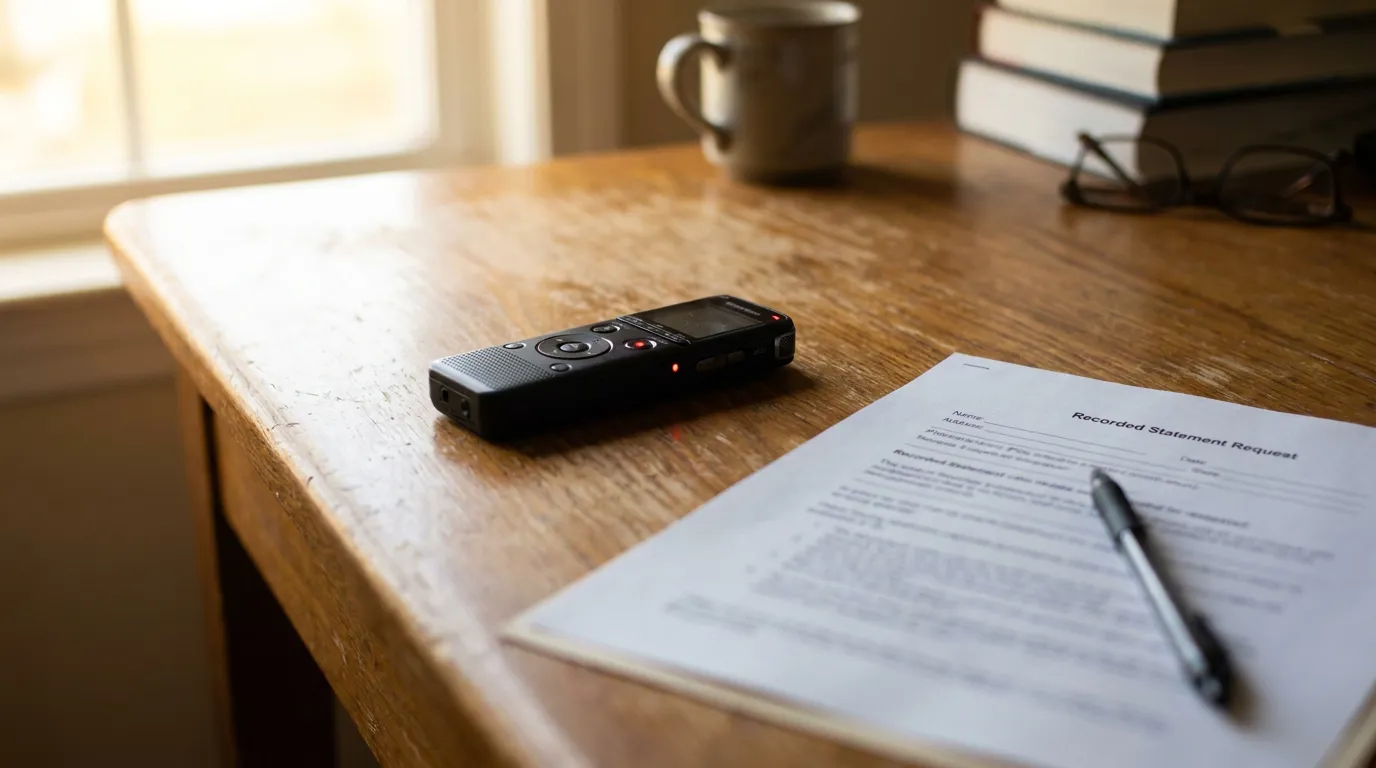
The purpose of a recorded statement is rarely to help the injured person. Consumer legal publisher Nolo explains that the goal is to lock you into a version of events, including the extent of your injuries and property damage. Once your account is on tape, any later clarification may be characterized as an inconsistency, even when the change reflects a diagnosis you didn’t have on day three.
Adjusters are trained to ask questions that sound neutral but carry legal weight. Typical questions probe your speed, direction, signal timing, weather, medications, alcohol use, phone location, and emotional state. Each topic may map onto a fault argument. A truthful answer like "I’d just refilled a prescription" or "my phone was in the cupholder" could be recast as an argument about distraction or impairment.
Early contact also aims at a fast, low insurance settlement. Adjusters often push for quick payment before an injured person understands how badly they are hurt. Signing the release that accompanies a settlement generally ends the right to seek more money later. This matters in cases involving soft-tissue injuries, concussions, or spinal damage, where the full picture may not emerge for weeks or months.
How Missouri’s Comparative Fault Rules Raise the Stakes
Missouri allocates responsibility by percentage, which is why adjusters hunt for admissions. Missouri’s pure comparative fault rule, established by the Missouri Supreme Court’s 1983 decision in Gustafson v. Benda for negligence cases and codified in RSMo § 537.765.1 for products liability claims, means fault percentages directly affect recovery.
Fault Can Be Pleaded Against You as a Defense
A defendant does not have to prove you caused the whole crash to reduce your recovery. Under Missouri’s comparative fault statute, a defendant may plead the plaintiff’s fault as an affirmative defense, and fault chargeable to the plaintiff may diminish compensatory damages proportionately without barring recovery. A statement given in week one may become the factual anchor for a fault argument in year two.
The 51% Threshold in Multi-Vehicle Collisions
Missouri uses a fifty-one percent line governing joint and several liability among defendants. Under RSMo § 537.067.1, a defendant bearing less than fifty-one percent of fault is responsible only for their percentage of the judgment, while a defendant at fifty-one percent or more may be held jointly and severally liable for the entire judgment. This threshold applies to defendants; it is not a bar to an injured plaintiff’s recovery. In multi-vehicle pileups, several carriers may each work to push their insured’s share below that threshold.
Punitive Damages Follow Their Own Allocation Rule
Punitive damages are handled severally. RSMo § 537.067.2 and.3 provide that defendants are severally liable for their attributed percentage of punitive damages and that no party may disclose this rule to the jury. Punitive damages are available only in narrow circumstances and are subject to separate statutory standards and limits.
Who You Actually Have a Duty to Cooperate With
Your obligations differ depending on whose policy is involved. Under your own auto insurance contract, you generally must provide timely notice of the crash and cooperate with your insurer’s investigation, which may include a statement. That duty arises from the policy language you agreed to. Failing to cooperate with your own carrier can support a coverage dispute, though Missouri insurers must typically show the lack of cooperation was material and prejudicial.
No comparable duty runs to the other driver’s carrier. You generally have no contract with them and are not legally required to speak with their representative outside formal discovery. Declining politely, providing basic identifying information, and directing further contact to counsel is usually permissible. The same caution applies with commercial carriers, which is why many people ask whether truck crash victims should talk to insurers before consulting an attorney.
| Insurer | Typical Duty | Recorded Statement |
|---|---|---|
| Your own auto insurer | Notice and cooperation generally required by policy contract | May be requested under the policy |
| At-fault driver’s insurer | Generally no legal duty owed | Generally not required by law |
💡 Pro Tip: Ask any adjuster to put requests in writing. A written request creates a record of what was asked and gives you time to review it with counsel before responding.
Practical Steps When an Adjuster Calls About a Recorded Statement Insurance Adjuster Car Accident Claim
You can often slow the process down without being uncooperative. Recorded and written statements are generally not required by law in the third-party context. In many cases, the information the adjuster legitimately needs may already exist in the crash report, photographs, and medical records.
- Confirm the caller’s name, carrier, and claim number before saying anything substantive.
- Decline to guess about speed, distance, or timing; "I don’t recall precisely" is honest.
- Avoid characterizing your injuries as "fine" or "not too bad" while treatment is ongoing.
- Do not sign broad medical authorizations that open your entire history.
- Ask for written communication and keep copies of everything.
💡 Pro Tip: Write down your own contemporaneous notes about the crash for your file. Notes prepared for your attorney are generally handled differently than a statement handed to an opposing carrier.
Time Limits Give You Room, But Not Unlimited Room
Missouri’s civil filing deadlines are longer than most people assume, though not unlimited. Missouri’s general five-year personal injury limitations period in RSMo § 516.120 means you generally do not need to rush into a recorded statement to protect a deadline. Other claims, such as wrongful death, carry shorter periods.
Deadlines still require careful attention. Tolling and accrual arguments generally apply only in limited circumstances, such as minority or incapacity. Claims against public entities can involve separate notice requirements, including ninety-day notice for certain municipal claims. The applicable period depends on the parties, the theory of liability, and the facts.
How Legal Representation Changes the Conversation
Once counsel is involved, adjusters generally direct communication through the attorney. That change removes the pressure of unexpected calls and allows evidence to be assembled before any narrative is locked in. A Missouri auto accident claim built on the crash report, scene photographs, vehicle damage analysis, and complete medical documentation may be more difficult to discount than one built around off-the-cuff recollection.
An attorney can also evaluate whether a statement is genuinely required. In first-party claims involving uninsured or underinsured motorist coverage, cooperation with your own carrier is typically owed under the policy. Working with a St. Louis car accident lawyer may help distinguish the obligations you owe from the requests you may decline.
Frequently Asked Questions
1. Can the adjuster deny my claim if I refuse to give a recorded statement?
A refusal to speak with the other driver’s carrier generally does not create a valid basis for denial. Because no contract typically exists between you and that insurer, there is generally no cooperation duty to breach. An insurer may still dispute the claim for other reasons, including contested liability, causation, or policy limits.
2. What if I already gave a recorded statement before hiring a lawyer?
A prior statement is not necessarily fatal to a car accident claim. Attorneys frequently work with clients who spoke early, using medical records, physical evidence, and expert reconstruction to place the statement in context. The sooner counsel reviews what was said, the more options may remain.
3. Do I have to give a statement to my own insurance company?
Usually yes. Standard auto insurance policies generally require prompt notice and cooperation with the insurer’s investigation. The scope and format can sometimes be negotiated, and an attorney may attend or prepare you for it.
4. Does saying "I’m okay" at the scene hurt my case?
It may be used against you, but it is rarely conclusive. Adrenaline commonly masks injuries, and delayed-onset symptoms are well documented medically. Prompt evaluation and consistent follow-up treatment may help demonstrate the actual timeline.
5. How long do I have to bring a Missouri personal injury claim?
Missouri’s general personal injury limitations period is five years under RSMo § 516.120, subject to important exceptions. Different periods apply based on claim type, defendant’s identity, and the claimant’s age or capacity. Confirming the applicable deadline early is prudent.
Protecting Your Claim Starts With What You Say First
A recorded statement to an opposing insurance adjuster after a car accident is generally a request, not a requirement, and in most third-party situations you may decline. Missouri’s comparative fault framework means fault is measured in percentages, and percentages are frequently built from words spoken before an injured person knows the full extent of their harm. Your duty to cooperate generally runs to your own carrier under the policy contract, not to the driver who hit you. Slowing down, documenting carefully, and getting guidance before talking to insurance representatives may protect far more than it costs in time.
You do not have to navigate an adjuster’s questions alone. Reach out to Halvorsen Klote Davis to discuss what happened, call the firm directly at (314) 451-1314, or learn more at hklawstl.com. A conversation before your next call with an adjuster can make a meaningful difference.
Disclaimer: This content is for informational purposes only and is not legal advice. Every case is unique, and results may vary. Consult an attorney about your specific circumstances.