What Roadside Cargo Inspections Reveal About Truck Crash Risk on Missouri Highways
Key Takeaways: Over 18,000 unsecured cargo violations reported in 2025 show that shifting, protruding, and falling loads are documented safety failures, not random accidents. Federal inspection records can make carrier securement history discoverable and support arguments about notice, negligent supervision, and causation. Missouri claimants may pursue negligence, negligence per se, or products liability theories, with width and marking rules under § 304.170.1 RSMo offering a concrete statutory hook. Oversize-load permits are conditional and may be void when requirements are ignored. Most personal injury and property damage claims fall under § 516.120 RSMo’s five-year period, though wrongful death has different deadlines. Pure comparative fault may preserve recovery even when trucking companies shift blame. Because straps, black-box data, and dashcam footage disappear quickly, early preservation efforts determine whether the strongest proof survives.
Inspectors across North America pull thousands of commercial vehicles out of service annually for load securement failures. The 18,000+ unsecured cargo violations in 2025 tells injured people that cargo which shifts, protrudes, or falls is often a documented safety problem rather than a freak accident. For someone struck by falling debris on I-70 or I-44, those inspection records may become useful proof. Violation data, driver inspection reports, and securement rules often supply the factual backbone of an unsecured cargo truck accident liability claim in Missouri.
If a shifting or falling load injured you or someone in your family, the window to preserve inspection and maintenance records is short. Halvorsen Klote Davis handles serious commercial vehicle cases throughout the St. Louis region. Call (314) 451-1314 or contact us now to discuss what evidence may still be recoverable.
Why Cargo Securement Violation Statistics Matter to Injury Claims
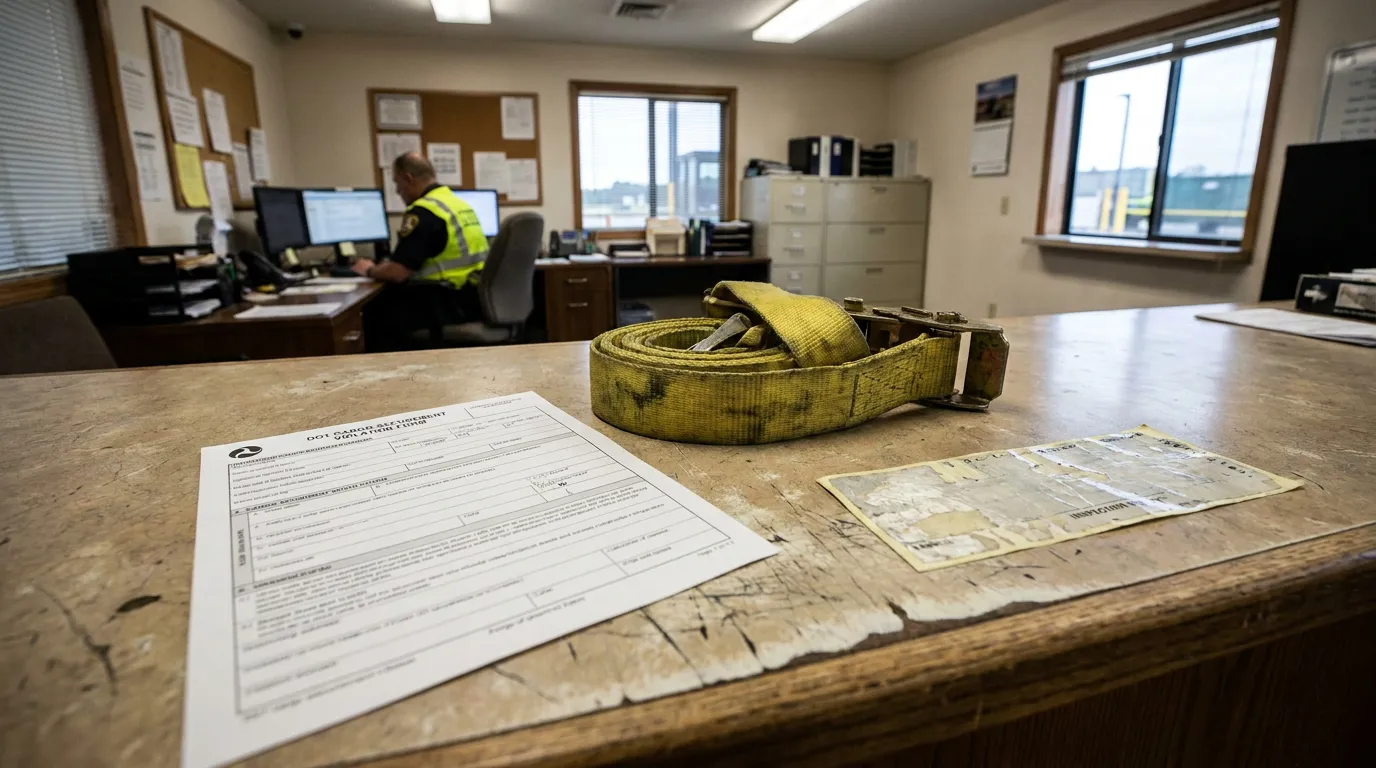
Enforcement numbers frame how a jury views a carrier’s conduct. CVSA inspection cargo violations are recorded in federal databases, making carrier securement history often discoverable in litigation. When a company has been repeatedly cited for loose straps, missing tiedowns, or improperly blocked freight, that pattern may support arguments about notice and negligent supervision, though Missouri courts frequently exclude prior-incident evidence unless the proponent shows sufficient similarity and relevance.
Cargo securement data also helps explain causation. A load appearing secure at a truck stop can migrate over hundreds of miles of vibration, braking, and turning. Strap tension recorded at pre-trip inspection may not match tension at crash time, which is why post-crash photographs of anchor points and strap wear matter.
FMCSA Cargo Rules Violations and What Inspectors Look For
Federal securement regulations set minimum standards for tiedown working load limits, blocking, bracing, and commodity-specific handling. Roadside inspectors evaluate whether tiedowns are adequate in number and strength, whether edge protection exists, and whether the driver conducted required en-route checks.
Common findings in load securement citation evidence include:
- Insufficient number of tiedowns for cargo length and weight
- Damaged, frayed, or knotted straps and chains
- Missing blocking or bracing on heavy equipment hauls
- Loads extending beyond trailer edge without required marking
- Failure to perform required en-route securement inspections
Proving Unsecured Cargo Truck Accident Liability Under Missouri Law
Missouri plaintiffs generally rely on ordinary negligence, negligence per se, or products liability theories. Missouri courts have recognized four elements for negligence per se in cargo cases: an actual statutory violation, a plaintiff within the class the statute protects, an injury of the type the statute was designed to prevent, and proximate causation, as discussed in Eckert v. Thole, 857 S.W.2d 543, 545 (Mo. App. 1993). Even a proven violation does not establish damages or defeat available defenses.
Width limits provide a concrete example. Under § 304.170.1 RSMo, a vehicle operated upon the highways of Missouri generally may not exceed one hundred two inches in width including its load, except for clearance lights, rearview mirrors, or other accessories required by law or regulation. Violations are punishable as a misdemeanor under § 304.240 RSMo. Missouri appellate discussion in King v. Morgan, 873 S.W.2d 272 (Mo. App. W.D. 1994), illustrates how overwidth loads may support more than an ordinary negligence claim.
Permits Do Not Automatically Excuse a Hauler
An oversize-load permit is generally conditional rather than a shield. In litigation underlying that width analysis, a blanket overwidth permit was treated as void because the eleven-foot-wide load lacked required "OVERSIZE LOAD" signs front and rear and carried only one of the required eighteen-inch fluorescent flags at the load’s extremities. Even so, a void permit does not by itself establish liability; the plaintiff must still tie the violation to the injury.
Missouri has not adopted strict liability for permit holders. Courts interpreting the permit responsibility clause have understood it as protecting the state highway commission through indemnification rather than creating automatic liability to injured members of the public.
How Dangerous Protruding Loads Actually Are
The consequences of a load extending past a trailer’s edge can be severe. In one Missouri case from April 1991 on Highway 58, a bulldozer blade protruding twenty-nine and a half inches past the trailer’s right side struck a roadside surveyor at forty miles per hour, causing serious head, shoulder, and arm injuries. Those facts illustrate why marking and width rules exist and why truck inspection violations in Missouri deserve close attention.
💡 Pro Tip: Photograph the trailer’s stake pockets, winches, and strap remnants before the tractor-trailer leaves the scene or a repair yard. That hardware frequently disappears from later inspections.
Deadlines That Govern Missouri Cargo Crash Claims
Missouri generally allows five years for most personal injury actions. The five-year statute of limitations in § 516.120 RSMo covers several relevant categories, but deadlines can shift based on the parties involved and the theory pleaded. Wrongful death claims are governed by the separate three-year period in § 537.100 RSMo, and claims involving minors may be affected by § 516.170 RSMo.
Property damage and bodily injury frequently travel together. Section 516.120(4) RSMo reaches actions for taking, detaining, or injuring goods or chattels and for other injuries to the person or rights of another not arising on contract. Claims premised on safety statute violations may fall under § 516.120(2) RSMo as liabilities created by statute, though personal injury claims are often analyzed under subdivision (4).
When the Trucking Company Blames You
Missouri’s comparative fault framework limits blame-shifting defenses. Under the Missouri products liability comparative fault statute, contributory fault as a complete bar to recovery is abolished, and pure comparative fault applies so that fault chargeable to the plaintiff diminishes compensatory damages proportionately without barring recovery. Ordinary negligence claims are governed by the judicially adopted pure comparative fault approach of Gustafson v. Benda, 661 S.W.2d 11 (Mo. banc 1983), which likewise reduces rather than bars recovery.
This matters when a failed ratchet, strap, or trailer component contributed to the crash. A claim against a component manufacturer does not automatically end because the injured person was allegedly inattentive, although plaintiff misuse or unforeseeable conduct can still affect defect and causation findings.
Admissions of Negligence and Your Right to Tell the Story
Some carriers admit negligence early, hoping to keep violation evidence away from the jury. Missouri commentary notes that the plaintiff is not required to accept the defendant’s admission of negligence. Appellate discussion in Kenney v. Myers, 674 S.W.3d 139 (Mo. Ct. App. 2023), addressed a plaintiff’s ability to introduce evidence relevant to liability even after an admission, though the scope of admissible evidence remains a trial court determination.
That principle carries real weight in cargo cases. If regulatory violations are central proof, being able to describe how the load was actually secured may shape a jury’s understanding of the harm. Understanding what a truck accident lawyer investigates helps clarify why this evidence is gathered early.
Evidence That Tends to Disappear First
Perishable proof drives many truck safety violation injury cases. ECM and black-box data may be overwritten, dashcam footage cycles, and damaged straps get discarded during repairs. A written preservation letter sent promptly may help prevent routine destruction, although preservation obligations and any spoliation remedy depend on the circumstances.
Records worth pursuing include driver inspection reports, dispatch and bill of lading documents, and the carrier’s prior violation history. Working with a Missouri truck accident lawyer early can help ensure that requests reach the right custodians before routine retention periods expire.
💡 Pro Tip: Ask the responding agency whether a commercial vehicle enforcement officer completed a separate inspection report. It is often filed apart from the crash report.
Frequently Asked Questions
1. Does a citation for unsecured cargo automatically prove the trucking company is liable?
No. A citation may be relevant evidence and may support a negligence per se theory if the four elements are satisfied, but admissibility and weight are decided by the court and finder of fact.
2. What if I was partly at fault for the collision?
In products liability claims, Missouri applies pure comparative fault under § 537.765 RSMo, meaning damages may be reduced by your share rather than eliminated. Ordinary negligence claims follow the comparable approach adopted in Gustafson v. Benda.
3. How long do I have to file a claim after a falling-cargo crash in St. Louis?
Most personal injury and property damage claims fall under the five-year period in § 516.120 RSMo, but exceptions exist. Wrongful death actions generally carry a three-year deadline under § 537.100 RSMo.
4. Can I still pursue a claim if the trucking company admits fault?
Generally yes. Missouri authority indicates a plaintiff is not required to accept an admission of negligence, though the trial court determines what evidence may be presented.
5. Does having an oversize-load permit protect the hauler?
Not necessarily. Missouri regulations provide that operation outside strict permit compliance can render the permit void, and permit responsibility language has been read as protecting the state rather than imposing strict liability.
Turning Enforcement Data Into Accountability
Unsecured cargo violation statistics reflect a hazard that Missouri drivers, passengers, and pedestrians encounter on interstates feeding into St. Louis. Missouri law offers several potential routes to accountability, from negligence per se based on width and marking rules to comparative fault principles that may preserve recovery even when a defendant blames the injured person.
Time and evidence work against injured people in cargo cases. Reach Halvorsen Klote Davis by calling (314) 451-1314 or request a case review to discuss your situation and what records should be preserved now.
Disclaimer: This content is for informational purposes only and is not legal advice. Every case is unique, and results may vary. Consult an attorney about your specific circumstances.