When Two Drivers Share the Blame for a Passenger’s Injuries
Key Takeaways: A Missouri motorcycle passenger can typically sue both the motorcycle operator and the other driver, as passengers are treated as separate injured parties who rarely bear crash responsibility. Missouri allocates fault by percentage under RSMo § 537.067.1: defendants found 51% or more at fault may be jointly and severally liable for the full compensatory judgment, while those below that threshold are responsible only for their allocated share. Punitive damages follow a different rule, with each defendant severally liable only for their own percentage. Missouri follows pure comparative fault, so any passenger fault reduces damages proportionately rather than barring recovery, with the defense bearing the burden of proof. Most personal injury lawsuits must be filed within five years under RSMo § 516.120(4), though wrongful death and public entity claims follow different timelines.
In many cases, yes. A motorcycle passenger injured in a St. Louis collision may pursue claims against both the motorcycle operator and the other driver, because Missouri law allows an injured plaintiff to name every party whose negligence allegedly contributed to the crash. Passengers rarely control speed, lane position, or reaction time, so fault often rests with one or both drivers.
If you were riding on a motorcycle and now face mounting medical bills, the team at Halvorsen Klote Davis can review how Missouri’s fault rules may apply to your crash. Call (314) 451-1314 or contact us now to discuss your options with a St. Louis motorcycle accident lawyer.
Why a Passenger Is Treated as a Separate Injured Party
Missouri courts recognize that a passenger is a distinct person with distinct rights. The passenger’s claim is evaluated on its own terms rather than rising or falling with the operator’s conduct. A passenger ordinarily has no duty to control the motorcycle, though they still owe a general duty of ordinary care for their own safety. This independence is the foundation of multi-party motorcycle claims in Missouri. If the operator misjudged a turn and the other motorist ran a light, both may have breached a duty owed to the passenger.
How Missouri Allocates Fault Among Multiple Defendants
Missouri uses a percentage-based system that determines not just who is liable, but how much each defendant must pay. Under Missouri’s joint and several liability statute, RSMo § 537.067.1, a defendant found to bear 51% or more of fault shall be jointly and severally liable for the full compensatory judgment. That 51% threshold is often the most important number in passenger cases.
Below that threshold, the arithmetic changes significantly. A defendant assigned less than 51% "shall only be responsible for the percentage of the judgment for which the defendant is determined to be responsible," subject to narrow exceptions including employee relationships and federal Employers’ Liability Act claims.
Why the 51% Line Matters When Insurance Is Thin
Joint and several liability can be the difference between a paper judgment and actual recovery. If the other motorist carries minimal coverage, but the motorcycle operator is assigned 51% or more fault, that operator may be legally responsible for the entire compensatory judgment, though insurer payment is capped by policy limits.
The statute has also been applied to governmental entities. Statutory annotations note that joint and several liability applied to the Missouri Highway and Transportation Commission without constituting unconstitutional diversion of highway funds (Smith v. Coffey, 37 S.W.3d 797). Claims involving public entities also carry separate sovereign immunity, damage cap, and notice considerations.
Punitive Damages Follow a Different Rule
Compensatory and punitive awards are not treated the same in Missouri. Under RSMo § 537.067.2, defendants shall only be severally liable for the percentage of punitive damages attributed to them by the trier of fact. A defendant does not absorb another’s punitive share, regardless of the 51% threshold.
Punitive damages also carry a heightened evidentiary burden. By statute, a plaintiff must prove by clear and convincing evidence that the defendant acted intentionally or with deliberate and flagrant disregard for safety.
| Type of Award | Defendant at 51%+ Fault | Defendant Below 51% Fault |
|---|---|---|
| Compensatory damages | May be jointly and severally liable for the full judgment | Generally responsible only for their allocated percentage |
| Punitive damages | Severally liable for their own percentage only | Severally liable for their own percentage only |
Comparative Fault and the Insurer’s Attempt to Blame the Passenger
Missouri applies pure comparative fault, so a passenger’s conduct may reduce recovery rather than destroying it. In negligence cases, that rule comes from the Missouri Supreme Court’s decision in Gustafson v. Benda. The Legislature codified a parallel rule for products liability claims in RSMo § 537.765.1.
Fault is not presumed against you. RSMo § 537.765.2 states that "Defendant may plead and prove the fault of the plaintiff as an affirmative defense." As an affirmative defense, comparative fault must be pleaded and proved by the defense.
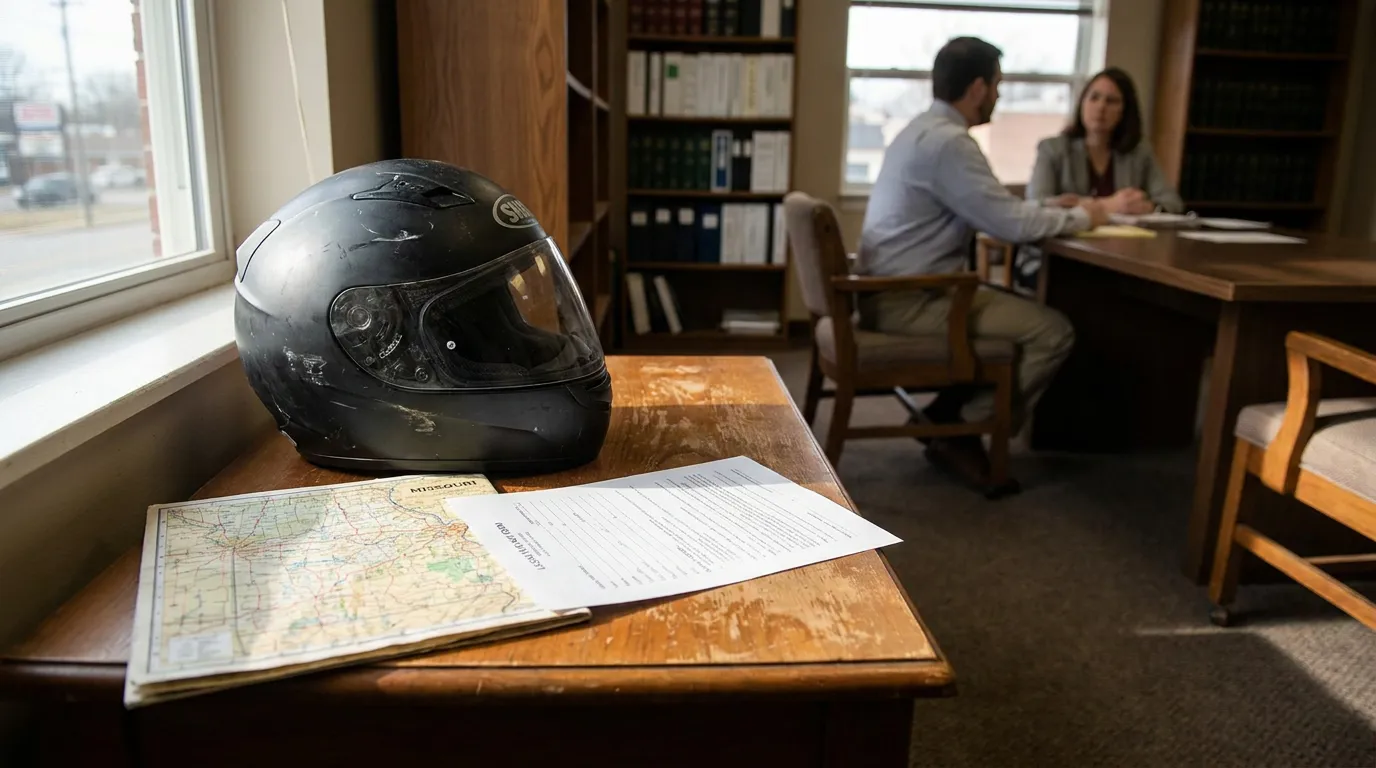
Expect protective-gear arguments. Missouri law is significant here: since August 28, 2020, qualifying riders and passengers aged 26 and older with proof of health insurance may ride without a helmet under RSMo § 302.026. However, under Missouri’s pure comparative negligence system, insurers and courts may still argue that not wearing a helmet contributed to the severity of a claimant’s injuries, potentially reducing their recovery.
💡 Pro Tip: Photograph your helmet, jacket, boots, and gloves before anyone discards them. Damaged gear can corroborate crash forces and may undercut an insurer’s narrative.
Building a Motorcycle Passenger Injury Claim Missouri Insurers Cannot Easily Dismiss
Evidence gathered in the first weeks can influence how fault gets apportioned years later. Because two drivers will frequently point at each other, a passenger benefits from independent documentation. Practical steps include:
- Requesting the full crash report and any supplemental investigation from the responding agency
- Preserving complete medical records, imaging, and treatment notes
- Identifying independent witnesses and nearby business or traffic camera footage before it is overwritten
- Documenting lost wages, missed shifts, and reduced earning capacity in writing
- Retaining the damaged motorcycle and vehicle data when reconstruction may be necessary
Visibility disputes are common. Federal guidance emphasizes that a motorcycle can be easily hidden in a car’s blind spots, which is why crash reconstruction and sight-line analysis frequently become central to passenger claims. If you are deciding whether to move forward, this overview of passenger injury claims in Missouri addresses several threshold questions.
What Jurors Are Not Allowed to Hear
Missouri deliberately keeps the payment consequences of fault allocation away from the jury. RSMo § 537.067.3 states that "In all tort actions, no party may disclose to the trier of fact the impact of this section." Jurors assign percentages without being told that crossing 51% may shift full financial responsibility.
The Filing Deadline That Applies to Both Drivers
Missouri generally allows five years to file a personal injury lawsuit arising from a motorcycle crash. The five-year deadline in RSMo § 516.120(4) covers personal injury actions not arising on contract.
Do not treat five years as universal. Wrongful death claims are governed by RSMo § 537.100, which sets a three-year limit. Claims involving governmental entities may carry separate notice requirements, such as the 90-day notice a claimant must give a municipality under RSMo § 82.210.
Tolling and delayed discovery are narrow, not automatic. Missouri courts generally interpret exceptions to limitations periods strictly, though RSMo § 516.170 tolls the period for minors and certain persons under legal disability.
💡 Pro Tip: Waiting is riskier than the five-year figure suggests. Skid marks fade, vehicles get repaired, and witness memories dim within months.
The Human Cost Behind These Cases
Motorcycle occupants remain sharply overrepresented in serious crashes. According to federal motorcycle safety data, 6,228 motorcyclists were killed in traffic crashes in 2024, representing 16% of all traffic fatalities. Passengers share that exposure without any control over the bike.
Severe injuries make the fault allocation question more consequential. When damages reach seven figures, a shift of a few percentage points may determine whether a judgment is fully collectible. A St. Louis motorcycle accident lawyer can evaluate coverage layers, including underinsured motorist benefits that may apply alongside the drivers’ liability policies.
Frequently Asked Questions
1. Can I sue the friend who was driving the motorcycle?
In many cases, yes. A passenger may name the operator as a defendant even in a friendship or family relationship, and such claims are typically defended and paid by the operator’s liability insurer up to the policy limits.
2. What if both drivers blame each other?
That is common. Missouri’s comparative fault framework allows the trier of fact to assign a percentage to each defendant, and RSMo § 537.067.1 then addresses how those percentages translate into payment obligations.
3. Does not wearing a helmet end my claim?
No. Missouri’s pure comparative fault rule means any proven passenger fault reduces damages proportionately rather than barring recovery. However, under Missouri’s pure comparative negligence system, insurers and courts may argue that not wearing a helmet contributed to the severity of injuries, which could potentially reduce recovery.
4. What if the at-fault driver has no insurance?
Uninsured and underinsured motorist coverage may apply, and joint and several liability under RSMo § 537.067.1 may shift full responsibility for the compensatory judgment to a defendant found at least 51% at fault.
5. How long do I really have to file?
Generally five years under RSMo § 516.120(4), though exceptions exist, wrongful death claims carry a three-year deadline, and claims against public entities may require notice within months.
Protecting Your Recovery After a Multi-Vehicle Crash
Missouri law can give injured passengers meaningful leverage. You may be able to name both drivers, comparative fault generally will not bar your claim, and the 51% threshold in RSMo § 537.067.1 may allow full recovery of compensatory damages from a single solvent defendant. Still, every one of these rules is fact-sensitive, and the percentages assigned in your case will depend on evidence that should be preserved early.
Do not let two insurers argue over percentages while your bills go unpaid. Reach out to Halvorsen Klote Davis at (314) 451-1314 or schedule your consultation to discuss your Missouri passenger lawsuit options.
Disclaimer: This content is for informational purposes only and is not legal advice. Every case is unique, and results may vary. Consult an attorney about your specific circumstances.