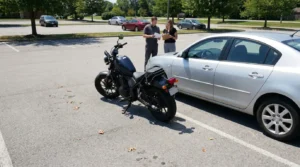
Why Road Rash Is More Than a Surface Injury
Key Takeaways: Road rash from a Missouri motorcycle accident can lead to real compensation when another party’s negligence caused the crash, since severe cases involve deep tissue damage, infection risk, nerve injury, and permanent scarring. A successful claim rests on the four negligence elements and strong medical documentation. Missouri’s pure comparative fault rule, adopted in Gustafson v. Benda and codified for products liability under RSMo § 537.765, reduces but does not eliminate recovery when a rider shares blame, and assumption-of-risk defenses rarely bar recovery without a signed release. Damages may include medical expenses, lost income, pain and suffering, and permanent scarring, with joint and several liability under RSMo § 537.067 holding defendants at least 51% at fault responsible for the full compensatory judgment. Riders generally have five years from the date of injury to file under RSMo § 516.120. Overcoming insurer bias takes organized evidence, credible witnesses, timely action, and often skilled legal advocacy.
Road rash can absolutely lead to compensation in Missouri when another party’s negligence caused your crash. While some dismiss road rash as a minor scrape, severe cases involve deep tissue damage, infection risk, nerve injury, and permanent scarring requiring surgery and skin grafts. When a motorist violates a duty of care and causes a St. Louis motorcycle accident, an injured rider may pursue both economic and non-economic damages under Missouri personal injury law.
If you are recovering from a motorcycle crash and facing mounting bills, the team at Halvorsen Klote Davis is ready to listen. Call our office at (314) 451-1314 or reach out through our online case review form to discuss your options. Early guidance can help protect your right to full recovery.
Building a Road Rash From Motorcycle Accident Claim
A successful road rash injury claim rests on the same four negligence elements that apply to any Missouri personal injury case. You must establish that the other party owed a duty of care, breached that duty, caused the collision, and produced quantifiable damages. Medical documentation is central because the depth, size, and location of the wound drive the claim’s value.
Strong evidence turns a disputed claim into a credible one. Consider gathering:
- Photographs of the wounds at each healing stage
- Complete medical records documenting debridement, skin grafts, physical therapy, and infection treatment
- The crash report, witness statements, and any available traffic or dashcam footage
- Records of lost wages and time missed during recovery
Insurers frequently minimize these injuries. Adjusters often argue that road rash heals quickly or that a rider assumed the risk simply by riding. Our discussion of why insurers undervalue road rash claims explains the common devaluation strategies Missouri riders face and how documentation counters them.
💡 Pro Tip: Ask your treating physician to note in your chart whether scarring is expected to be permanent. That single detail can significantly affect how non-economic damages are evaluated.
How Comparative Fault Shapes Your Recovery
Missouri applies pure comparative fault, meaning your own share of blame reduces but does not eliminate your compensation. This is critical protection for motorcyclists, who often face unfair assumptions that they were speeding or riding recklessly. Even if a rider bears some responsibility, road rash damages remain recoverable in a proportionally reduced amount.
Pure Comparative Fault Explained
Missouri’s pure comparative fault rule comes from both case law and statute. For an ordinary motorcycle crash caused by another driver’s negligence, the doctrine applies through the common law adopted in Gustafson v. Benda. The legislature codified the same principle for products liability claims: RSMo § 537.765(1) provides that contributory fault is abolished as a complete bar, and that pure comparative fault shall apply. RSMo § 537.765(2) adds that "Any fault chargeable to the plaintiff shall diminish proportionately the amount awarded as compensatory damages but shall not bar recovery." You can review the full text of this comparative fault statute through the Missouri Revisor of Statutes.
This framework traces back to a landmark decision. The Missouri Supreme Court adopted pure comparative fault in Gustafson v. Benda, 661 S.W.2d 11 (Mo. banc 1983), directing courts to apply the doctrine in accordance with the Uniform Comparative Fault Act. Under that act, a claimant’s contributory fault "diminishes proportionately the amount awarded as compensatory damages… but does not bar recovery." Being blamed for part of a crash does not automatically shut the door on a road rash injury claim.
Assumption of Risk and Signed Releases
Not every "you knew the risks" argument holds up in Missouri. Courts distinguish among express, implied primary, and implied secondary assumption of risk, and generally only an express agreement completely bars recovery. Express assumption of risk occurs when the plaintiff expressly agrees in advance that the defendant owes no duty.
The absence of a signed release usually weakens this defense. Missouri courts have noted when plaintiffs "did not sign a release," which is common for everyday motorcyclists on public roads. Because these determinations are highly fact-dependent, outcomes can vary from case to case.
Understanding Damages and Who Pays
Road rash damages can include medical expenses, lost income, pain and suffering, and compensation for permanent scarring. How much a defendant ultimately pays depends in part on Missouri’s rules for allocating fault among multiple responsible parties, especially important when more than one driver contributed to a motorcycle accident.
Joint and Several Liability for Compensatory Damages
Missouri law allows a heavily at-fault defendant to be responsible for the entire judgment. Under RSMo § 537.067.1, if a defendant is found to bear fifty-one percent or more of fault, that defendant is jointly and severally liable for the amount of the judgment. This can be significant for an injured motorcycrist pursuing full compensation when several parties share blame but only one has meaningful insurance coverage.
Juries generally do not learn how this allocation affects the payout. Under RSMo § 537.067.3, no party may disclose to the trier of fact the impact of this section. That is one reason how a case is presented and documented can influence the fault percentages a jury assigns.
Punitive Damages Work Differently
Punitive damages follow a separate, narrower rule. Under RSMo § 537.067.2, each defendant is only severally liable for the percentage of punitive damages attributed to that defendant. Joint and several liability does not extend to punitive awards.
| Type of Damages | How Liability Is Allocated |
|---|---|
| Compensatory (defendant ≥ 51% at fault) | Jointly and severally liable for full judgment |
| Punitive | Severally liable only for own fault percentage |
The Clock Is Ticking on Missouri Filing Deadlines
Missouri generally gives injured motorcyclists five years from the date of injury to file most personal injury claims. RSMo § 516.120 sets a five-year limitation for "any other injury to the person or rights of another, not arising on contract and not herein otherwise enumerated." This five-year limitations statute is the primary civil deadline for negligence claims arising from a crash.
That deadline matters because severe injuries often delay legal action. Riders undergoing months of surgery and physical therapy may focus on healing rather than paperwork, yet missing the deadline can permanently forfeit the right to sue. Filing suit generally stops the clock, and Missouri courts have held that filing a petition and issuance of summons halt the running of the statute, provided the plaintiff makes a good-faith attempt at service, as in Emanuel v. Richards, 426 S.W.2d 716 (Mo. 1968).
The deadline is not permanently fixed. The Missouri legislature has repeatedly attempted to shorten it, with proposals such as S.B. 631, 101st Leg., 2d Reg. Sess. (Mo. 2022) seeking to lower the period to two years from the date of injury. Because the law can change and courts interpret deadline exceptions narrowly, do not assume the current five-year period will apply indefinitely.
💡 Pro Tip: Do not wait until the deadline approaches to preserve evidence. Skid marks fade, cameras overwrite footage, and witness memories dim long before any statute of limitations expires.
Standing Up to Insurer Bias Against Riders
Motorcyclists frequently encounter bias that treats them as inherently reckless, which can affect settlement offers. Countering that bias requires organized medical proof, credible witness accounts, and sometimes crash reconstruction to establish exactly how the other driver breached a duty of care. A well-supported file signals that a claim is prepared for litigation if a fair road rash settlement is not offered.
Working with a knowledgeable advocate can help level the playing field. Our motorcycle accident attorney Missouri team focuses on documenting rider injuries and pushing back against unfair fault-shifting.
Frequently Asked Questions
1. Is road rash serious enough to justify a claim?
Yes, severe road rash often justifies a claim. Deep wounds may require skin grafts, cause permanent scarring, and create infection risks, all contributing to economic and non-economic damages.
2. Can I still recover if I was partly at fault for the crash?
Generally, yes. Under Missouri’s pure comparative fault system, adopted in Gustafson v. Benda and codified for products liability in RSMo § 537.765, your compensation is reduced by your percentage of fault but recovery is not barred entirely.
3. How long do I have to file a road rash claim in Missouri?
Most personal injury claims fall under a five-year deadline. RSMo § 516.120 generally provides five years from the date of injury, though exceptions exist and are interpreted narrowly.
4. What if more than one driver caused my crash?
Multiple defendants may share responsibility. Under RSMo § 537.067.1, a defendant found at least fifty-one percent at fault can be jointly and severally liable for the full compensatory judgment.
5. Will signing a waiver prevent me from suing?
It depends on the type of waiver. Only an express written agreement typically bars recovery, and many everyday riders never sign such a release, though these determinations are highly fact-specific.
Protecting Your Right to Full Compensation
Road rash from a Missouri motorcycle accident can lead to meaningful compensation when negligence caused the crash. Between the state’s pure comparative fault protections, its five-year filing window, and joint liability rules that hold seriously at-fault drivers accountable, injured riders have real legal tools available. Success depends on strong medical documentation, credible evidence, and timely action.
If road rash or another motorcycle injury has disrupted your life, the attorneys at Halvorsen Klote Davis are here to help you understand your options. Call (314) 451-1314 or request your consultation online to take the next step toward the recovery you deserve.